


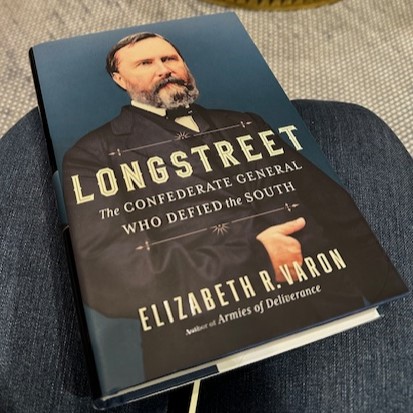
I was back at the Atlanta History Center last week to hear Elizabeth Varon discuss her latest release Longstreet: The Confederate general who defied the South. I’m a history buff at heart and loved the discussion and what I’ve read of this book so far – I read the first three chapters before the event started! Varon is a professor of American History at the University of Virginia and writes as both a biographer and educator. This book follows the life of James Longstreet known for his efforts during the Civil War as well as his political activism after the war.
If you would like to avoid spoilers or too much detail, please skip ahead by clicking here.
The author pointed out during the discussion that Longstreet is considered the #3 man in the Confederate hierarchy behind Jefferson Davis and Robert E Lee. He weilded great power during the war, but it was how he chose to use that power after the war that I found interesting.
During the war, Longstreet was with Lee at Gettysburg, but he also participated in several other important battles, like Chicamauga where he was seriously wounded. Longstreet is often villainized today for his actions at Gettysburg. Varon was quick to point out that the criticism was not contemporary to the war or even in the early years after – it came much later as opposition looked to discredit Longstreet’s work as a political operative. Robert E Lee never held a grudge against Longstreet for what happened that day and the two men remained close for years.
Prior to the war, Longstreet held a commission with the US Army. He studied at West Point and was a classmate of Ulysses S. Grant, even becoming close friends with him. Both gentlemen courted their wives during the same period, and the women were distant cousins. This long friendship put them at odds during the Civil War but brought them together again during the surrender at Appomattox. Grant offered terms of leniency that would allow a fresh start and unity between the sides. Longstreet took Grant at his word and used this offer as the basis for how he shaped his post-war life.
Longstreet was a war hero and well-respected leader in the community when he moved to New Orleans after the war. He worked as a cotton broker until his activism began to have a negative effect on his partners and he left their business. During his time in New Orleans, Longstreet was looking to promote peace and prosperity, but the political environment was very divisive at the time. He led a militia to quell political violence and served on a school board looking to integrate the public schools there. New Orleans was also a unique political environment in that black political leaders were able to hold office and campaign where it was frowned upon in many former Confederate areas.
Pre-war, Longstreet had believed in slavery, states rights, and succession. Post-war, he saw the value of reconstruction and giving ground on both sides to find a common path forward. In 1867, a newspaper reached out for his opinion on the reconstruction plans Congress was putting forward. He agreed to write a series of letters to be used as editorials, but first reached out to his former commander Robert E Lee to see if he would support the letters as well. However, the die-hard Confederate was appalled at Longstreet’s plea and this began the end of their friendship. Longstreet submitted four letters asking the public to give reconstruction a shot at success and emploring them to be patient with the efforts.
Lee wasn’t the only ex-Confederate to feel betrayed by these writings. Many leaders called Longstreet a traitor for his opinions. However, Republican leadership welcomed him with open arms. Longstreet ended up moving back to Georgia and spent the last 30 years of his life as a political operative, holding many offices in the Republican governments of the time. He was also a farmer and ran a hotel in Gainesville. Among his offices, he was Postmaster General of Georgia, Ambassador to Turkey, and US Marshall over the state of Georgia. These led to some interesting carreer points as well, including the Yarborough case where Longstreet and his men arrested several people to quell violence in opposition to voting rights. This case made it all the way to the Supreme court where it was ruled that the US Government can protect voting rights from violence – an important ruling for the future and impacting the Civil Rights movement in the 60’s and the more recent violence we have seen against voters.
When he returns to Georgia, Longstreet spends a good bit of time defending his war record and other efforts. He writes a 690-page memoir on his experiences to put his version of events out there for the readers and continues to write letters to many individuals and journalists giving a unique ability for researchers to understand the events of his life and his thoughts.
I found it interesting that Longstreet’s legacy was probably carried on further by his second wife. She was 42 years younger than Longstreet and was his partner in rehabilitating his image. She was a powerful figure in her own right as a journalist during World War II and as a riveter at the Bell plant in Marietta, Georgia at age 80.
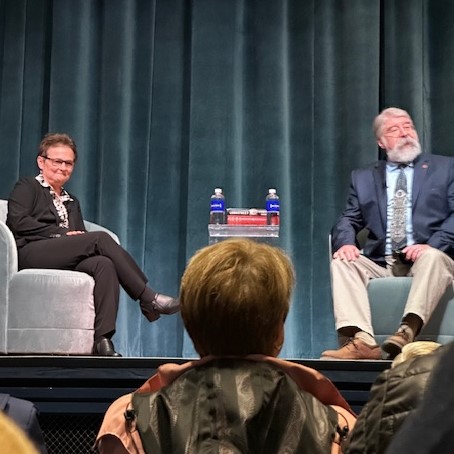
Varon stated very plainly that this book is a lens into reconstruction from the point of view of Longstreet – not a definitive document on the period. She also commented that Longstreet was too changeable to be honored with statues at this point – his first intention was for the Confederates to win, but ultimately sought harmony and peace after the war by making concessions. His friendship with Grant gave him the nudge towards peacemaking, but also to reform his reputation to earn the positions of power he later held.
This was a very interesting discussion – I took 6 pages of notes on the events of Longstreet’s life! Have you read Longstreet yet? I’d love to hear your thoughts in the comments below!
This post contains affiliate links.
What I’m Reading
- Current print book: Africatown, Nick Tabor
- Current audio book: Same Time, Next Year, Debbie MacComber
- Book I’m most looking forward to: Open Carry, Marc Cameron
Discover more from Read With Lindsey
Subscribe to get the latest posts sent to your email.
