

In the 1890s, the Lakota were living mainly peaceful lives on the land the US Government had reserved for them. The Pine Ridge Reservation isn’t exactly their ancestral lands, but the government thought it was close enough. While the Lakota were free to work the land and hunt game, the army still harassed them from time to time, rounding them up and directing them where to make camp. That’s exactly how December 29th of that year started – General Custer had moved a band of Lakota to a new area and his men were attempting to disarm the warriors. In the process, a shot was fired – no one knows for certain from which side – and a mele ensued killing at least 150 men, women, and children of the tribe, and wounding many more. Most people consider this the end of “Indian History” in America – you don’t see or hear much from indigenous tribes until the late 1990’s and early 2000’s when they protested the oil pipelines scarring their sacred lands. But these are not people who have sat idly by and let history speed past them. They are warriors and stewards of our environment. They are keepers of traditions and languages so easily forgotten by the government.
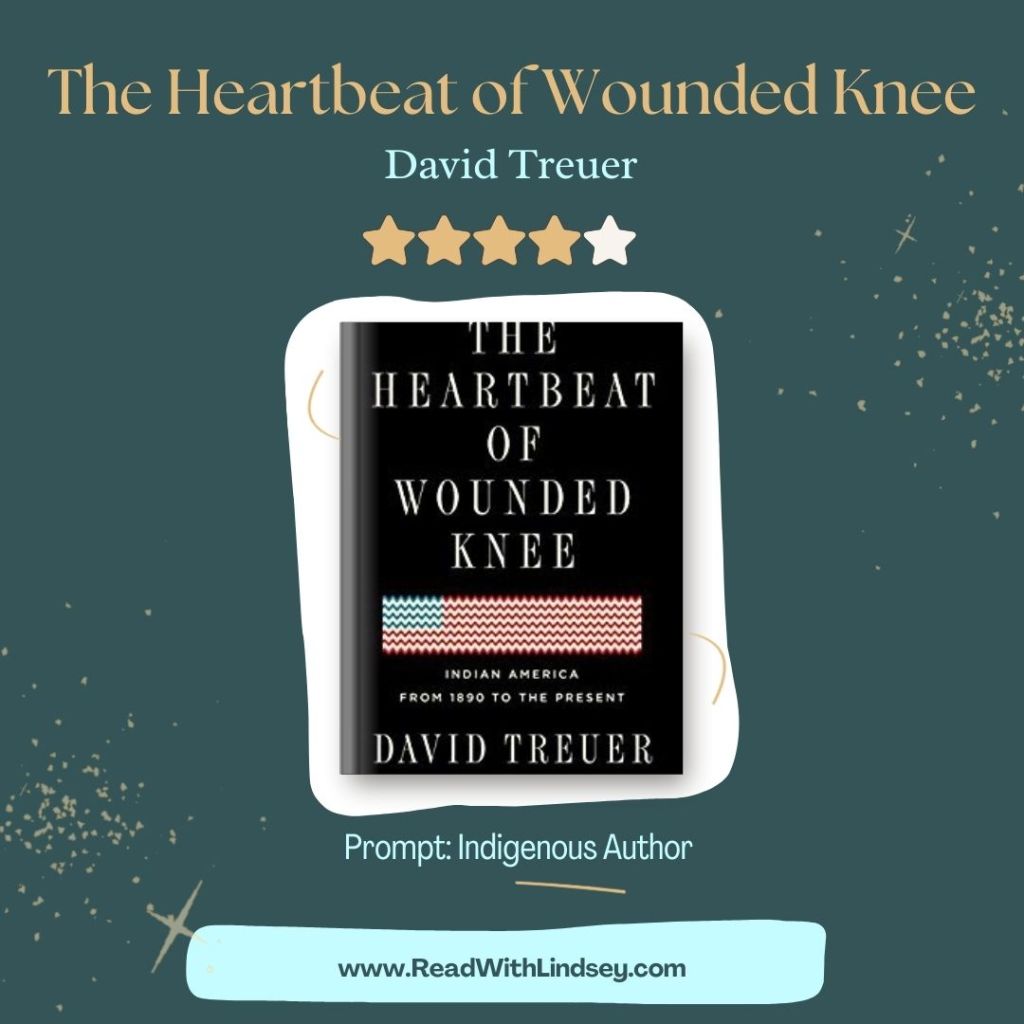
David Treuer is from the Leech Lake Reservation in Minnesota and a member of the Ojibwe Nation. His writings often share his heritage, but The Heartbeat of Wounded Knee is so much more. Part history book, part memoir, this work takes readers inside some of the most poignant moments in American History not from the perspective you already be familiar with, but from that of the indigenous people fighting for their Civil Rights, their property rights, and their religious freedoms. This award-winning work reminds readers that the Battle of Wounded Knee did not occur in ancient history, but in the relatively recent past. This was 25 years after the Civil War and the height of the Gilded Age. This was the year Dwight D Eisenhower and Colonel Sanders were born. And it was the start of modern American history. Indigenous peoples did not dissolve into the larger populous. They did not give up their fights for freedoms Americans at large could tout. In this book, Treuer shows the fight continued throughout the 20th century, and continues today.

I give The Heartbeat of Wounded Knee 4 out of 5 stars. The topic of Indigenous Rights has been of interest to me for over 20 years. I was first introduced to the notion that all the history I learned in public school was tainted by the lens of the US Government as a freshman at Georgia State University. As part of the honors program, I was invited to take a Native American Philosophy course and those lessons have stuck with me for decades. Treuer’s work here to share the other side of the events in invaluable. He does great work to show how the governments oppression of the indigenous peoples did not stop in 1890, but continued with actions and rules throughout the next century. Environmental racism we first read about this year in the poor, African American communities in Alabama, is rampant in the government’s decisions involving the Reservations as well. I was surprised to learn that events like the pipelines aren’t new – they have been ongoing for many years. My only complaint with this book is that sometimes it does become hard to read simply because of the heaviness of facts and data. However, I can’t see how the author could have edited it in a better manner without losing so much valuable information
If you are looking for a comprehensive study of modern Indigenous history, this is a great place to start. There were so many events I hadn’t heard of before included in this text, and some told from different perspectives. I would also think this book would make a great accompaniment to a Native American studies course like the one I took at Georgia State. I would also recommend this book to those looking to connect with their indigenous ancestry – while there are many other works that cover early history, this book shows the recent struggles that impact current day life on reservations.
I chose The Heartbeat of Wounded Knee for the Read With Lindsey Reading Challenge prompt “Indigenous Author”. We have actually read quite a few works by indigenous authors this year including Code Talker. If you are looking to dive into some of the origin stories and religious texts mentioned in this work, I would suggest trying Dine Bahane’: The Navajo Creation Story. It was the required reading in that college course I took and helped me understand the connection between nature and spirituality for the Navajo – something that the government has never understood.
This post contains affiliate links.
What I’m Reading
- Current print book: The Cardinal of the Kremlin, Tom Clancy
- Current audio book: Open Season, Archer Mayor
- Book I’m most looking forward to: Virgin River, Robyn Carr
Discover more from Read With Lindsey
Subscribe to get the latest posts sent to your email.

2 thoughts on “The Heartbeat of Wounded Knee”