

This past Thursday, I was at the Atlanta History Center for another author discussion and book signing. Peter Stark was in town discussing his recent release Gallop Toward the Sun: Tecumseh and William Henry Harrison’s struggle for the destiny of the nation. This talk was different from others I’ve attended in so many ways, and was so much fun! This was more of a history lecture than a book discussion and I took pages of notes. I enjoyed the talk and a one-on-one conversation I had with Stark at the book signing, but what made this a unique experience was something outside of the plan: a fire alarm. Mid discussion, the building fire alarm went off and we were all ushered outside to wait for the Atlanta Fire Department to clear the building before we could resume the conversation. I had a great time chatting with others who frequently attend these chats and the AHC staff while we waited! The staff mentioned this was the first time in all the years of these events that an alarm went off. I’m happy to say they cleared us to resume and we never saw anything out of the ordinary.
Before the discussion, I like to take ten minutes to scan through the book we are going to discuss. I start with any back cover or flap texts, then the introduction, prologues, author’s notes, or additional information that might be included. Stark included both an author’s note and a prologue at the beginning of the book that were fascinating to me. The author’s note details the care he has taken to use language and terms acceptable to the tribes when referring to these groups and his attempt to reference tribal affiliation when possible. The prologue sets the scene for the overall book by detailing the formal encounter Tecumseh and William Henry Harrison had to negotiate terms based on their diverging visions for the future of the West. This is where the discussion started with Stark reading from these pages.
If you would like to avoid spoilers or too much detail, please skip ahead by clicking here.
I was struck by several things in this prologue. The first being how similar Tecumseh and Harrison’s lives were. Starck mentioned this was what drew him to their stories as well. Each suffered the loss of their father early in life and their mothers effectively stopped parenting. Both men’s fathers were well known in politics and the area – Tecumseh was the son of chief and warrior; Harrison’s father was a founding father and head of the Second Continental Congress which passed the Declaration of Independence. Both also saw their homes destroyed by raiders and benefitted from the leadership of their father’s supporters.
The second piece that struck me was jockeying for the upper hand throughout this pivotal encounter. While they were at Harrison’s property, Tecumseh set the actual location of the talk, directing the men away from the house and into the woods. Harrison was in his full dress uniform with sword during this discussion and Tecumseh’s men kept their knives and weapons close. But the conflict came to a head when Tecumseh stated he didn’t want war, but they were ready if it came, to which Harrison tried to justify his actions and authority by stating Tecumseh was the first chief to ever question his motives. Tecumseh was then angered when the translator failed to convey the accurate emotion of his message and the two men grew frustrated with teh talks.
Another aspect I picked up on during our discussion was how close both men were to other great men. For instance, Tecumseh formed alliances with other great tribal leaders and his family included his sister, a female Shawnee chief, and his brother, a prophet. Harrison’s connections go a little further into the world of important men: he briefly attended medical school in Philadelphia under Doctor Benjamin Rush, who advocated for the humane treatment of the mentally ill and later was the treasurer of the US Mint. William Randolph, a founder of the College of William and Mary, offered Harrison a job in his office while serving as the first Attorney General. Light Horse Harry Lee, father of Robert E Lee, told Harrison he would be better off to enter the army and help quell the Indian conflicts in the Ohio River Valley when he was just 18. George Washington, his father’s roommate during the Continental Congress meetings, made an exception to grant him an officer’s title (you had to be 20 to be an officer) and sent him to war. I found it interesting how many different names from this conversation also showed up in the biography I recently read on John Marshall, Chief Justice of the Supreme Court. This was central to the conversation I had with the author during the book signing – these men all ran in the same circles of influence.
In a funny turn, Stark was later asked during the Q&A about any tie between Tecumseh and General William Tecumseh Sherman due to their names. Sherman fought against Robert E. Lee in the Civil War. Stark stated that Sherman’s father, as well as historians, thought Tecumseh was an amazing man and leader. Initially, the family wanted to name their son Tecumseh Sherman, but the minister who baptized the baby told them he would not baptize a child with a pagan name, so they added William to the front.
In terms of the government’s relationship with the tribes, I found it interesting how the conflict really kicked off. Harrison reached out to President Jefferson, stating he could gain more tribal lands for the government and Jefferson tells him to do it, but quickly. They decided to get the chiefs into a large amount of debt to force the tribes to turn over their land to repay it. In 1809, Tecumseh told the government they could have no additional lands and worked to build an alliance that would require all tribes to consent to a sale by any of the alliance members.
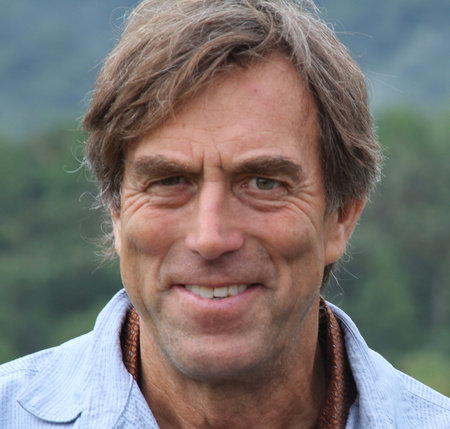
Given my poor choice of seat for the discussion and some lighting challenges, I wasn’t able to grab a photo of Stark during the discussion as I have recently. This photo comes from his publisher’s PR team.
During the QA session, Stark was asked about the title of the book. He mentioned it was from a comment Tecumseh made during the negotiations, stating that if the US continued doing these land purchases, they would be driving the tribes west like a horse galloping towards the sunset (paraphrased). Stark also stated that the climax of this book is a battle in the War of 1812 where the two men fought against each other.
If you have been following my posts about the author discussions, you may remember my comments after my previous event at the Atlanta History Center about the heckler who disturbed the Q&A. I was pleased we didn’t encounter anything like that on this evening. I was also pleased to see an increase in security personnel onsite for this discussion. While this group of attendees was different in many ways from the last, I appreciated the extra care. Especially after our fire alarm fiasco! To my friends at the Atlanta History Center: thank you for putting on these great events, and thank you for keeping us safe!
If you already have your copy of Gallop Toward The Sun, share your thoughts below!
This post contains affiliate links.
What I’m Reading
- Current print book: The Rules of Magic, Alice Hoffman
- Current audio book: Lawrence in Arabia, Scott Anderson
- Book I’m most looking forward to: Nights in Rodanthe, Nicholas Sparks
Discover more from Read With Lindsey
Subscribe to get the latest posts sent to your email.
