
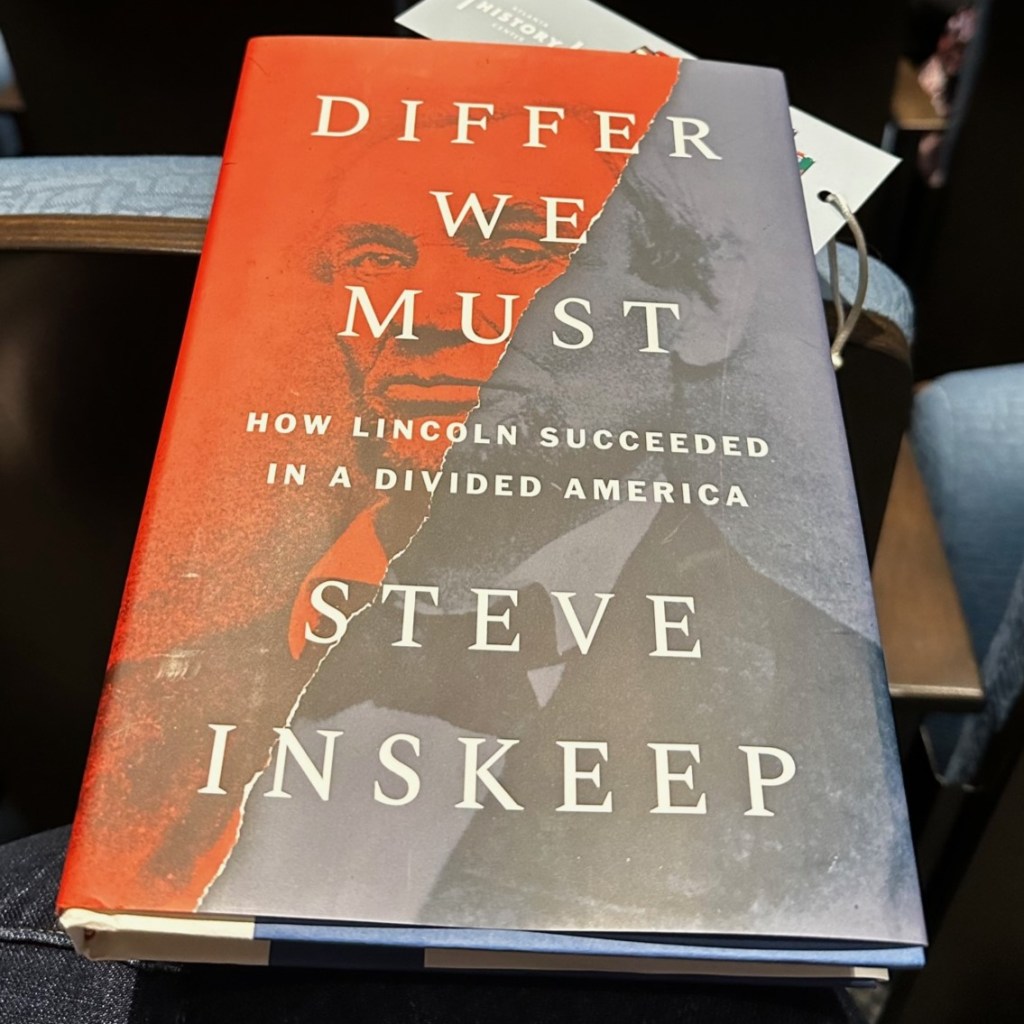
Earlier in the week, I was at the Atlanta History Center again for an author discussion and book signing. This time it was Steve Inskeep discussing his new release Differ We Must: How Lincoln succeeded in a divided America. You may recognize Inskeep from his work as a journalist and NPR host. He is also the author of several books taking a look at historical events from unique perspectives, and this newest book is no different. Focusing on 16 interactions Lincoln had with a variety of people, this book shows how Lincoln was able to build coalitions when the political environment was so divided.
In the author notes for this book, and again in the conversation, Inskeep discussed that he began writing this book while simultaneously covering the 2020 election and aftermath as a journalist for NPR. He talked loosely about the parallels between Lincoln’s presidency and that of more recent administrations. The author’s notes also bring up the need for more technologically advanced access to research resources and to make them available to the public – most of this research was completed during the pandemic when he couldn’t gain access to physical libraries and repositories. As with any discussion of a political figure, the conversation did turn to a political discourse, but the author and facilitator did their best to keep it light and directed towards Lincoln instead of current events.
If you would like to avoid spoilers or too much detail, please skip ahead by clicking here.
When asked why he chose this subject matter to research, Inskeep reminded the audience that what you study influences other parts of your life. In the author’s case, this meant that his study of Lincoln influenced the way he chose to report the news of the 2020 election and the events of January 6, 2021. Inskeep also stated that those events influenced the way he studied Lincoln as well – it is hard to silo studies, work, and personal life and they often influence each other.
Inskeep did state that he hesitated to write about Lincoln. As the facilitator noted, Lincoln is probably the most well documented and researched presidents in American history. However, Inskeep stated that Lincoln had appeared as a supporting character in his other recent works, leaving the author with an urge to dig into the president. Inskeep also discussed how his upbringing influenced his subject choice. Having grown up in Indiana in areas near where Lincoln spent portions of his life, Inskeep said Lincoln was always nearby.
In discussing the man behind the presidency, Inskeep stated that Lincoln didn’t exactly look to convert others to his viewpoint, but to build coalitions based on common goals or values. Lincoln used a humble approach to every conversation and was aware he was a smart person, but didn’t demonize his opposition, just acknowledge both the differences and the common ground. For instance, when he met with Frederick Douglas after the Emancipation Proclamation was issued and Douglas had become a military recruiter for the Union. Douglas grew angry with the administration and the president because they weren’t delivering on promises of equal pay to black soldiers. Lincoln acknowledged and apologized for the shortcomings but chose to explain why it was happening in a frank tone, allowing Douglas a peek behind the curtain. They did not walk away agreeing that either man was in the right, but that there were problems with equality, and something needed to be done.
One of the recurring themes of the conversation Wednesday was the parallel between Lincoln’s presidency and that of the last few Democratic Party presidents. In relation to Biden, both men suffered the loss of children and their families suffered mental health challenges. Like Clinton, Lincoln was able to talk to and relate to everyone he encountered. The most striking similarities though are found with Obama. In short, both looked to bring the country together into the Purple American as opposed to Republican Red and Democratic Blue. Both men came from a similar geographic area. They also both attacked systems that held people down and looked to improve, never saying that things were “fixed”, only better than they had been. Lincoln and Obama both liked to approach conversations with critics by making the mater personal and trying to show the other party why their beliefs or actions would be good for them. Even though both presidents were coalition builders, both eras ended in political extremism that further divided our country.
In closing, Inskeep discussed how Lincoln felt constrained by the constitution. The president held on issuing the Emancipation Proclamation until there was a constitutional need. Inskeep also believes that Lincoln would have pushed for as much equality as the states could endure during reconstruction and wanted new political structures to support that goal, but states’ rights took precedence. Lincoln had a view of human nature that all societies needed agreed upon rules or laws to govern themselves and he supported the constitution as a legal rule book, but saw its shortcomings, too.

During the Q&A, Inskeep discussed several other discussions Lincoln had that are recounted in the book, but also stated that most of these discussions may not be the ones we expect to see. Many are lesser-known interactions, not usually covered by historians, but they played a role in the larger political environment at the time. The book is divided into three movements: Coalition (assembling the people to oppose slavery), Separation (secession of the Confederate States), and Union (bringing people of different views together to support the Union). Each person involved is given a nickname, my favorites being “Conspiracy Theorist” for Duff Green and “Sovereign” for Lean Bear. The title of this book comes from a letter the president sent to his slave-holding best friend that included the line “If for this you and I must differ, differ we must.”
I hope you will enjoy this book as much as I enjoyed this discussion! In its first week of sales, the book hit the New York Times best seller list and is making waves in my historical biography groups! I will say that, for the first time, I felt a bit uneasy at this author event for no reason of the author’s making. Given the current political and world events, there were hecklers in the crowd pushing the author to discuss the events of the day in the Middle East. The author and facilitator did an excellent job keeping the discussion on track, but I wish the History Center had better security or plan of action for this type of situation. There was no in person signing afterwards, and I’m almost thankful for that given the turn the Q&A session took with the hecklers.
If you already have your copy of Differ We Must, share your thoughts below!
This post contains affiliate links.
What I’m Reading
- Current print book: A Man Called Ove, Fredrik Backman
- Current audio book: Magic Lessons, Alice Hoffman
- Book I’m most looking forward to: The Rules of Magic, Alice Hoffman
Discover more from Read With Lindsey
Subscribe to get the latest posts sent to your email.
